
Scale Personalized Google Review Response Examples in Under a Minute
Scale Personalized Google Review Response Examples in Under a Minute
Thank the reviewer by name, repeat one specific detail from their comment, and sign off with a real name or role. That’s the whole formula, and it works for almost any five-star review you’ll ever get. Skip the generic “Thanks for your feedback!” line. A reply like “Thanks, Maria! So glad the quick turnaround on your kitchen faucet worked out. See you next time. Dave, Owner” takes 20 seconds and does more for your reputation than a paragraph of corporate gratitude.
TL;DR:
- Responding promptly within 24 hours strengthens customer trust and enhances your business reputation.
- Personalize replies by mentioning specific details from the review to prove genuine engagement and avoid generic responses.
- Use one to three concise sentences that reference the reviewer’s name and detail, ensuring responses sound authentic and friendly.
- Avoid public incentives or discounts in replies, as this can violate platform policies and reduce credibility.
- Manage reviews efficiently with a unified inbox and templated responses that include personalization tokens to maintain a natural, consistent tone.
Table of Contents
- Google Review Response Examples for Every Situation
- What Makes a Google Review Reply Actually Work?
- How Do You Adapt Templates by Industry?
- Can You Offer a Discount in a Review Reply?
- How Automation Helps You Scale Personalized Replies
- How Do You Handle a Mixed or Borderline Positive Review?
- What Response Mistakes Backfire Most Often?
- What Legal and Ethical Lines Should You Watch?
- Why Small Replies Build Bigger Reputations
- Reply to Every Five-Star Review Without the Manual Grind
- Sources
- FAQ
Google Review Response Examples for Every Situation
You don’t need a different reply strategy for every star rating and review type. You need a small library of options you can grab, tweak in ten seconds, and post. Below are the actual templates broken out by scenario, because a five-star review with no text needs a completely different reply than one that name-drops your best technician.
Short thank-you replies for 5-star reviews with no comment
These happen constantly. Someone leaves five stars and nothing else. Don’t overthink it. A short, warm reply is exactly right here, and trying to write a paragraph for a blank review looks strange.
- “Thanks so much for the five stars, [Name]! We appreciate you.”
- “Really glad you had a great experience, [Name]. Thanks for taking the time to leave a review!”
- “Five stars means a lot to us, [Name]. Thank you!”
- “Appreciate you, [Name]! Hope to see you again soon.”
- “Thank you, [Name]! Reviews like this keep us going.”
Detailed replies that reference specific product or service details
When someone writes even a sentence about what they liked, mirror it back. This is the single biggest upgrade you can make to a review reply, because it proves a real person read what they wrote instead of pasting a canned response.
- “Thanks, [Name]! We’re thrilled the new patio set held up so well through the storm season. That’s exactly the kind of durability we look for before we stock a product.”
- “So glad the same-day appointment worked with your schedule, [Name]. We know how stressful a broken water heater is, and we’re happy we could get you sorted fast.”
- “Thank you for the kind words about the fit, [Name]! Our tailor spends extra time on inseams for exactly this reason, and it’s great to hear it paid off.”
- “We appreciate you noticing the attention to detail on the trim work, [Name]. That’s a point of pride for our whole crew.”
- “Thanks, [Name]! Hearing that the consultation felt unrushed means we’re doing exactly what we set out to do.”
Templates that credit a specific staff member
A review that names an employee is a gift. Use it publicly, both because that employee deserves the credit and because a named human being in a reply reads far more authentic than a business voice alone.
- “Thank you, [Name]! I’ll make sure Carlos hears how much you appreciated his patience walking you through the paperwork. He’ll be thrilled.”
- “So glad Jenny took great care of you, [Name]. She’s one of our best, and comments like yours make her day.”
- “We’re passing this along to Marcus, [Name]. He takes real pride in getting the little details right, and it shows.”
- “Thank you for calling out Priya by name, [Name]. She’s going to love reading this.”
First-time customer replies
New customers are worth acknowledging differently than repeat ones. A first-time reviewer often has some hesitation about whether this business is a fluke or the real deal. Confirm it was the real deal, and invite them back.
- “Thank you for giving us a shot, [Name]! We’re so glad your first visit lived up to the hype, and we can’t wait to see you again.”
- “Welcome to the [business name] family, [Name]! Really appreciate you trusting us with your first project, and we’re glad it went smoothly.”
- “So glad we made a good first impression, [Name]. That’s exactly what we aim for with every new customer.”
Loyal, repeat-customer replies
Regulars deserve a reply that acknowledges the relationship, not just the transaction. This is where you can get a little more personal, because you likely know more context about them.
- “You’ve been with us for three years now, [Name], and reviews like this remind us why we love having you as a customer. Thank you!”
- “Always great seeing you, [Name]! Thanks for sticking with us and for the kind words.”
- “It means a lot coming from someone who’s seen us grow over the years, [Name]. Thank you for your continued trust.”
- “You’re one of our regulars for a reason, [Name], and we’re grateful you keep coming back.”
Influencer, ambassador, or referral-mention replies
If someone mentions they found you through a friend, an influencer, or a referral program, acknowledge the source. It signals to future readers that word of mouth is working for you, which is its own form of social proof.
- “Thank you, [Name]! So glad your friend pointed you our way. We love when word travels like that.”
- “We’re grateful you gave us a try after seeing our page, [Name]. Reviews like yours are what keep that momentum going.”
- “Thanks for the shoutout, [Name]! Referrals from happy customers are the best compliment we can get.”
One caution here: templates are a starting point, not a script to run word for word every time. Repeating identical replies across dozens of reviews is easy to spot and can make a business look automated in a bad way, even when the sentiment is genuine. Swap the opening line, change the detail you reference, and keep the sign-off varied.
What Makes a Google Review Reply Actually Work?
Speed, brevity, and specificity. Those three things separate a reply that builds loyalty from one that gets skimmed and forgotten.
Respond fast. Industry guidance points to same-day or within-24-hours as the sweet spot for handling reviews well, and that window applies just as much to good news as bad. A five-star review answered within a few hours feels like a conversation. The same review answered three weeks later feels like an afterthought, even if the words are identical.
Keep it short. One to three sentences is plenty. Longer replies read as performative, and most readers skim past them anyway. If you find yourself writing a fourth sentence, ask whether it’s adding information or just padding.
Personalize every time. Run through this quick checklist before you hit post:
- Did you use the reviewer’s name?
- Did you reference something specific from their review, not a generic compliment?
- Did you sign with a real name and role, not just the business name?
- Does the tone match how you’d actually talk to this person in your store or office?
Understand the SEO angle, but don’t force it. Google treats consistent review engagement as a signal of an active, well-managed local business profile, and replies that naturally mention your service type or neighborhood can reinforce relevance for local search. That said, cramming keywords into a thank-you reply (“Thanks for choosing our top-rated emergency plumbing services in [City]!”) reads as spam to both humans and, likely, to Google’s own systems. Mention what you do because it’s true, not because you’re trying to game a ranking.
Watch for template fatigue. If a reply could be pasted under any business’s review with zero edits, it’s too generic. The tell is usually a total absence of nouns. “Thanks for your feedback!” could apply to a bakery or a law firm. “Thanks for trusting us with your tax filing this year!” could only be one business.
Pro Tip: Keep three or four different opening lines in rotation (“Thank you,” “So glad to hear,” “Really appreciate,” “Thanks so much”) and swap between them. It takes zero extra effort and prevents your review section from looking like a copy-paste job to anyone scrolling through it.
Research on this isn’t just intuition, either. A Harvard Business Review study found that businesses that reply to reviews see measurably better ratings over time than those that stay silent. Responding changes how customers perceive the business, not just how the reviewer feels about their own experience.
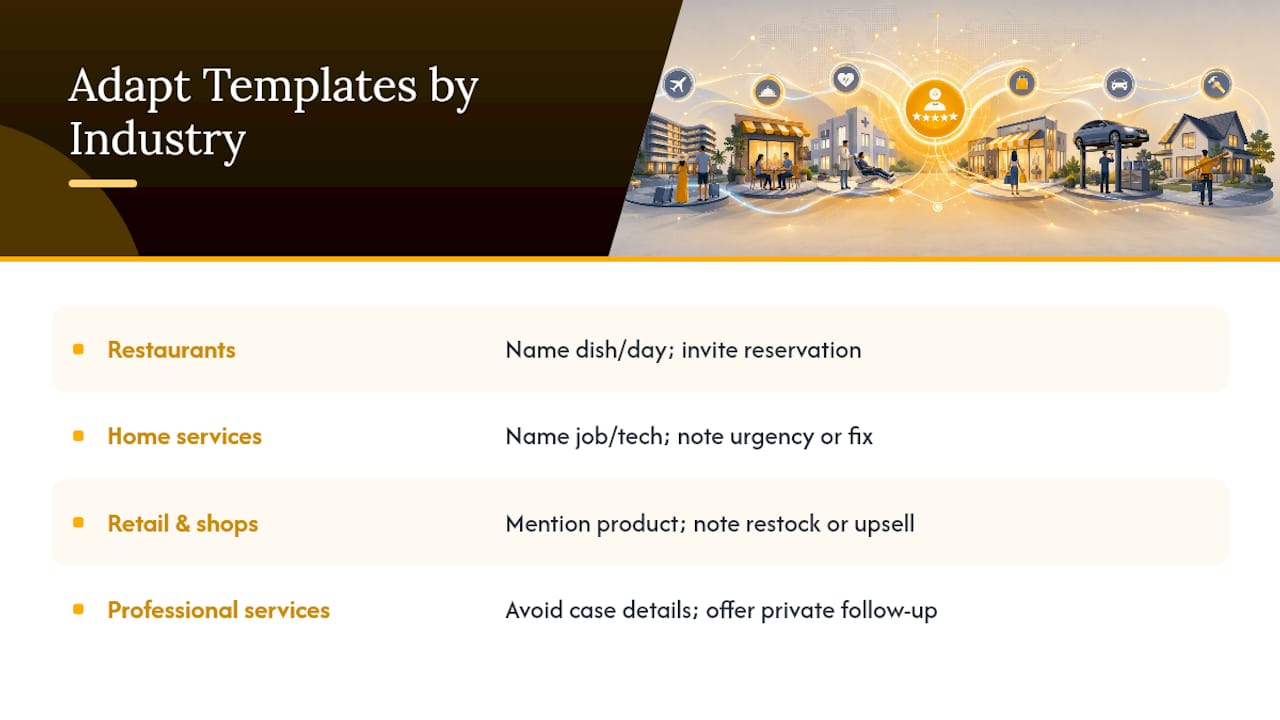
How Do You Adapt Templates by Industry?
The three-part formula holds everywhere. What changes is which detail you pull out and what you invite the customer to do next.
Restaurants: Reference the specific dish, the day, or the occasion, and invite them back or point toward a reservation. “Thanks, [Name]! So glad the Friday special hit the mark, especially with the new short rib. Hope to see you at the table again soon.” Time-based details (weekend brunch, a holiday menu, a specific server) make the reply feel like it belongs to that exact visit.
Home services: Name the job and, where you have one, the technician or crew. “Thanks, [Name]! Glad Ray got that water heater swapped out same-day. He’ll appreciate hearing it.” Home service reviews often mention urgency or a specific fix, so lean into that rather than a generic “great service” line.
Retail and shops: Mention the actual product, and where it fits naturally, note restocking or a related item. “So glad the wool sweater fit perfectly, [Name]! We just got a few more colors in if you’re ever back in.” This is one of the few places where a light product mention doubles as a soft upsell without sounding like an ad.
Professional services (legal, medical, financial, consulting): Privacy matters more here than anywhere else. Never confirm details about the nature of someone’s case, diagnosis, or account, even if the reviewer mentioned it themselves. “Thank you for the kind words, [Name]. We’re glad the consultation was helpful, and we’re here if you need anything else.” A generic but warm reply protects both the client and the business, and following up on scheduling or next steps is better handled privately.
Across every vertical, the same rule holds: reference something true and specific, and let the industry context dictate what that detail is.
Can You Offer a Discount in a Review Reply?
Be careful here. Google’s policies prohibit incentivizing reviews, and offering a discount in exchange for a review (or implying one in a public reply) can cross that line even when your intentions are good. The safest move is to thank the reviewer sincerely in public and move any offer, referral perk, or loyalty program mention to a private channel like email, text, or a direct message.
If you want to nod toward a referral program or loyalty perks without sounding transactional, keep the phrasing subtle:
- “Thanks, [Name]! If you know anyone else looking for [service], we’d love an introduction.”
- “So glad you loved it. Keep an eye on your inbox, we’ve got a little something coming your way for regulars like you.”
- “Appreciate you, [Name]! We’ll send over a small thank-you separately.”
None of these promise anything specific in public, and none of them ask for the review in exchange for a reward. If you do want to extend a real discount or referral bonus, send it through a private message, a follow-up email, or a text through your usual customer communication channel.
It reads as a solicitation, it can violate platform policy, and it undercuts the sincerity of the reply you just wrote.*
How Automation Helps You Scale Personalized Replies
The hardest part of review management isn’t writing one good reply. It’s writing fifty good replies a month without burning out or slipping into copy-paste mode. That’s where a structured workflow, not just good intentions, makes the difference.
A workable setup looks like this: new Google reviews trigger an alert to a unified inbox, a trained team member drops in a personalization token (the customer’s name, the product, the staff member mentioned), and a human reviews the reply before it publishes. This kind of alert-and-template pattern keeps response times fast without making every reply feel manufactured.
The operational payoff is real:
- Consistent tone across every reply, even when different team members are posting them.
- A trackable response rate, so you know if reviews are sitting unanswered for days.
- Less manual searching across email, Google Business Profile, and social platforms to find new reviews.
The risk with any templated system is sounding robotic, and the fix is simple: rotate several approved opening lines and require a personalization token before anything gets published. That single rule is what keeps templated replies from reading as repetitive to customers scrolling through your profile.
A platform built around a similar workflow provides a unified inbox that catches new Google reviews alongside SMS, email, and webchat messages, so nothing sits unanswered because it landed in a tab nobody checks. Templating with personalization tokens speeds up the writing without stripping out the human part, and monitoring tools give a clear read on how fast a team is actually responding. None of that replaces a real person reading the review. It just makes sure that person has time to do it well.
How Do You Handle a Mixed or Borderline Positive Review?
A four-star review with a mild complaint tucked inside (“Great food, but the wait was long”) needs a different tone than a pure five-star rave. Ignore the compliment and you look tone-deaf. Ignore the complaint and you look like you didn’t read it.
The move is to thank them for the positive part first, then address the specific issue directly and briefly. “Thanks, [Name]! Really glad the food hit the mark. We’re working on kitchen timing during peak hours, and we appreciate you flagging it.” That’s it. No defensiveness, no over-explaining, no discount offer dangling in public.
Resist the urge to argue with a three or four-star review that feels almost unfair. A short, gracious reply does more for your reputation than a long justification, because future readers are watching how you handle friction, not just praise. If the complaint involves something specific and resolvable, like a wrong order or a scheduling mix-up, offer to make it right through a private channel rather than litigating it in the reply thread.
One useful habit: if a mixed review triggers any defensiveness in you while reading it, wait before responding. A short cooling-off period before drafting a reply to anything with criticism tends to produce a calmer and more useful response than a same-hour reaction.
What Response Mistakes Backfire Most Often?
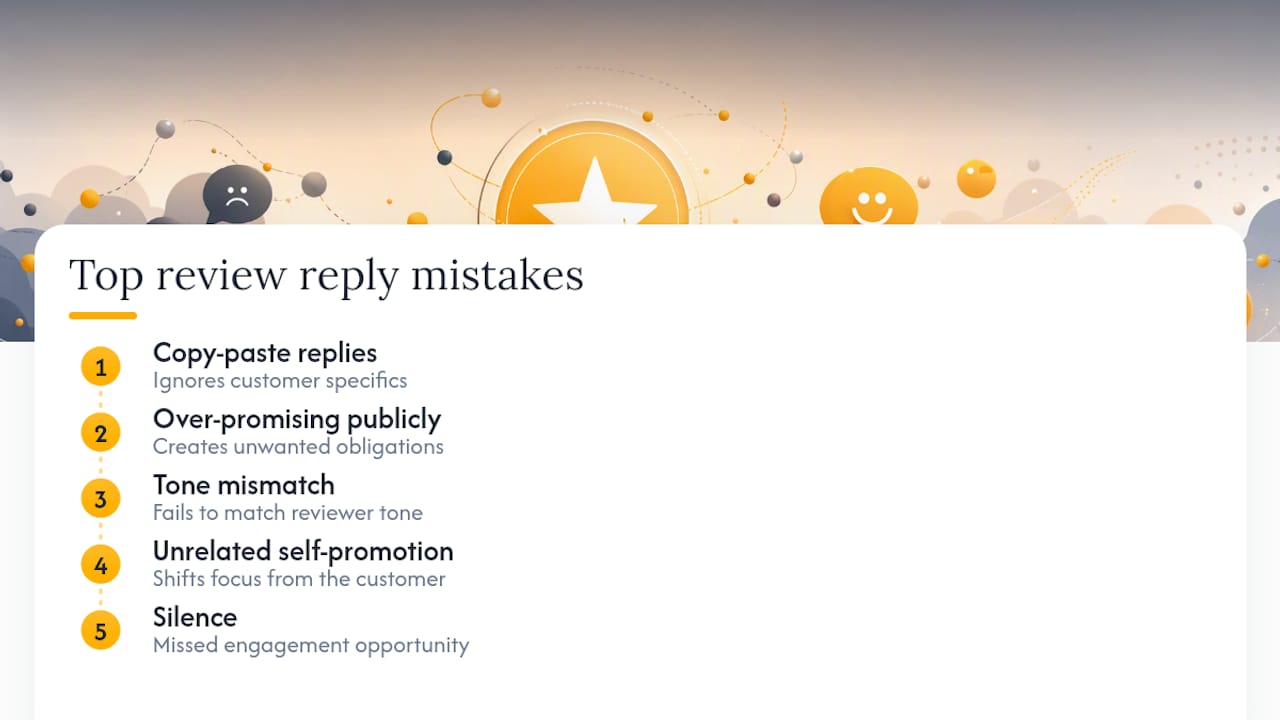
The most common mistake is the copy-paste reply that ignores what the customer actually wrote. If someone mentions your new espresso machine by name and you reply with “Thanks for your feedback!”, it reads as though nobody on your team actually read the review.
A close second: over-promising in public. Writing “come back anytime for a free dessert” in a reply that dozens of strangers can see creates an obligation you may not have meant to make, and it edges toward the kind of review-incentive language platforms discourage.
Third, treating every reply the same regardless of tone. A giddy, exclamation-point-heavy review deserves a warmer, more casual reply than a measured, professional one. Matching tone shows you actually read the review rather than running it through a mental template.
Fourth, using the reply to promote unrelated products or services. A five-star review about a haircut is not the place to mention your new retail line. It reads as opportunistic and drags attention away from the customer who took the time to write something nice.
Finally, silence. Not replying at all to positive reviews is a missed opportunity, especially since engagement with reviews correlates with better overall ratings over time. Every unanswered five-star review is a small, free win left on the table.
What Legal and Ethical Lines Should You Watch?
Public replies are, well, public. Anything you write can be quoted, screenshotted, and read by people who have never interacted with your business. That changes what’s safe to say.
Never confirm private details in a reply, especially in medical, legal, or financial contexts. Even if a reviewer mentions their diagnosis, case type, or account details, repeating those specifics back in your reply can create privacy exposure that has nothing to do with your intent and everything to do with confidentiality obligations tied to your profession.
Avoid promising outcomes you can’t guarantee. “We’ll always get you the best price” or “your results will look exactly like this” in a public reply can be read later as a commitment, particularly in regulated industries.
Don’t incentivize future reviews in a public thread. Beyond violating platform policy, it can also create the appearance of manufactured feedback, which erodes the very trust you’re trying to build.
And be honest about attribution. If a reply is written by an assistant, a manager, or a team member other than the business owner, that’s fine, but don’t fabricate a persona or claim an experience that didn’t happen. Authenticity is the entire point of replying at all.
Why Small Replies Build Bigger Reputations
A short, sincere reply rarely feels like it matters in the moment you write it. But the customers who get a genuine reply, one that clearly references what they said, are noticeably more likely to come back and mention it again the next time they leave feedback. That pattern shows up again and again in how repeat customers talk about a business: they remember being heard, not just served.
The compounding effect is what people underestimate most. One good reply doesn’t move the needle. Fifty of them, written consistently over months, start to look like a business that pays attention, and that reputation shows up in ways beyond the star rating itself. It shows up in referrals, in returning customers, and in the quiet trust that builds when someone reads your review section before ever walking through your door.
— Kentarian
Reply to Every Five-Star Review Without the Manual Grind
Some platforms give local businesses a faster path than manually checking Google, email, and social messages for new reviews every day. Instead of hunting across different apps to find and answer a review, everything lands in one inbox, with personalization tokens ready so replies still sound like written by a person, not a script.
Here’s how the flow actually works: a new Google review comes in, triggers an alert, and populates a template with the reviewer’s name and the specific detail worth referencing. A team member reviews it, adjusts the wording if needed, and publishes it in under a minute. The same platform also handles follow-up, whether that’s collecting a deposit through text-to-pay invoicing after a service call or continuing the conversation through webchat if a happy customer wants to book again. If you’re currently juggling review replies between three different logins, start a trial and see what one unified inbox does for your response time.
Sources
A few sources back up nearly everything in this guide, and they’re worth returning to if you want the deeper research behind the advice:
- Replying to customer reviews results in better ratings | Harvard Business Review
- How to handle negative Google reviews | Search Engine Land
FAQ
What is a good response to a Google review?
A good response thanks the reviewer by name, repeats a specific detail from what they wrote, and signs off with a real name or role. Keep it to one to three sentences and skip generic phrasing that could apply to any business.
What are some examples of how to respond to a positive Google review?
“Thanks, [Name]! So glad the same-day repair worked out. See you next time. [Your name], Owner” is a solid model. The key parts are the name, a specific reference, and a personal sign-off, not a scripted-sounding phrase.
What are some good 5-star review examples to reply to?
Reviews that mention a specific product, staff member, or detail are the easiest to reply to well, because you can mirror that detail back. Even a blank five-star rating deserves a short, warm thank-you rather than silence.
What should I write in a response to a 3-star review?
Thank the reviewer for the positive parts of their comment first, then address the specific concern briefly and without defensiveness. Offer to resolve anything fixable through a private message rather than debating it publicly, and consider using a unified messaging platform like Brownbagconsultant to route that follow-up conversation.