Launch Two Way Texting in Two to Four Weeks for Local Businesses
Launch Two Way Texting in Two to Four Weeks for Local Businesses
Two-way texting lets customers reply to your business messages and get a real response, turning a broadcast channel into an actual conversation. Adopt it now because it shortens the time between a customer’s question and your answer, and that speed tends to lift conversion on bookings, order confirmations, and abandoned carts. The catch: deliverability depends on getting registration and opt-in right before you send a single message.
TL;DR:
- Using 10DLC registration and matching message content to your use case are crucial for avoiding silent filtering and ensuring message deliverability.
- Response rates and response times are key KPIs, with response rate indicating engagement and response speed reflecting operational efficiency.
- Starting with one workflow and gradually expanding after proving operational success helps prevent overload and improves staffing effectiveness.
- Automation handles the predictable 80% of replies, but staffing for the remaining 20% is essential to maintain customer trust and satisfaction.
- Integrating all customer messages into one unified inbox simplifies escalation and staffing, increasing the success of your two-way texting pilot.
Table of Contents
- What Is Two-Way Texting, and How Is It Different From One-Way SMS?
- How Two-Way Texting Works: Numbers, Keywords, and Automation
- Business Use Cases That Actually Move Revenue
- Best Practices for Compliance, Message Design, and Channel Choice
- Implementing Two-Way Texting: Integration, Workflow, and Staffing
- Costs and Deliverability: What 10DLC Really Means for Your Budget
- Measuring Success: The KPIs That Prove It’s Working
- Why Most Businesses Get Two-Way Texting Backwards
- Pilot Two-Way Texting With Brownbagconsultant
- Sources
What Is Two-Way Texting, and How Is It Different From One-Way SMS?
One-way SMS is a megaphone. You send appointment reminders, sale alerts, or shipping updates, and the conversation ends there. Two-way texting keeps that same phone number open for the customer to write back, so a single thread can carry a whole exchange instead of a single blast.
The distinction matters because two-way SMS converts outbound messaging into an actual conversation rather than a one-directional push. A dental office texting “Your appointment is tomorrow at 2 PM” is one-way. The same office texting “Your appointment is tomorrow at 2 PM. Reply C to confirm or R to reschedule” and then routing that reply into a calendar system is two-way.
Here’s where each approach earns its place:
- One-way fits: mass alerts, delivery notifications, weather closures, one-time codes.
- Two-way fits: customer service questions, order changes, appointment logistics, sales follow-up.
- Hybrid fits: a promo blast (one-way) that ends with “Reply YES for 20% off” (two-way).
A short exchange shows the difference in practice:
Business: “Your table for 4 is ready. Reply HERE when you arrive.” Customer: “HERE” Business: “Great, you’re up next. About 5 minutes.”
That three-line thread replaces a phone call, a hold queue, and a host walking the parking lot. It also builds a permanent record you can search later, something a phone call never gives you.
How Two-Way Texting Works: Numbers, Keywords, and Automation
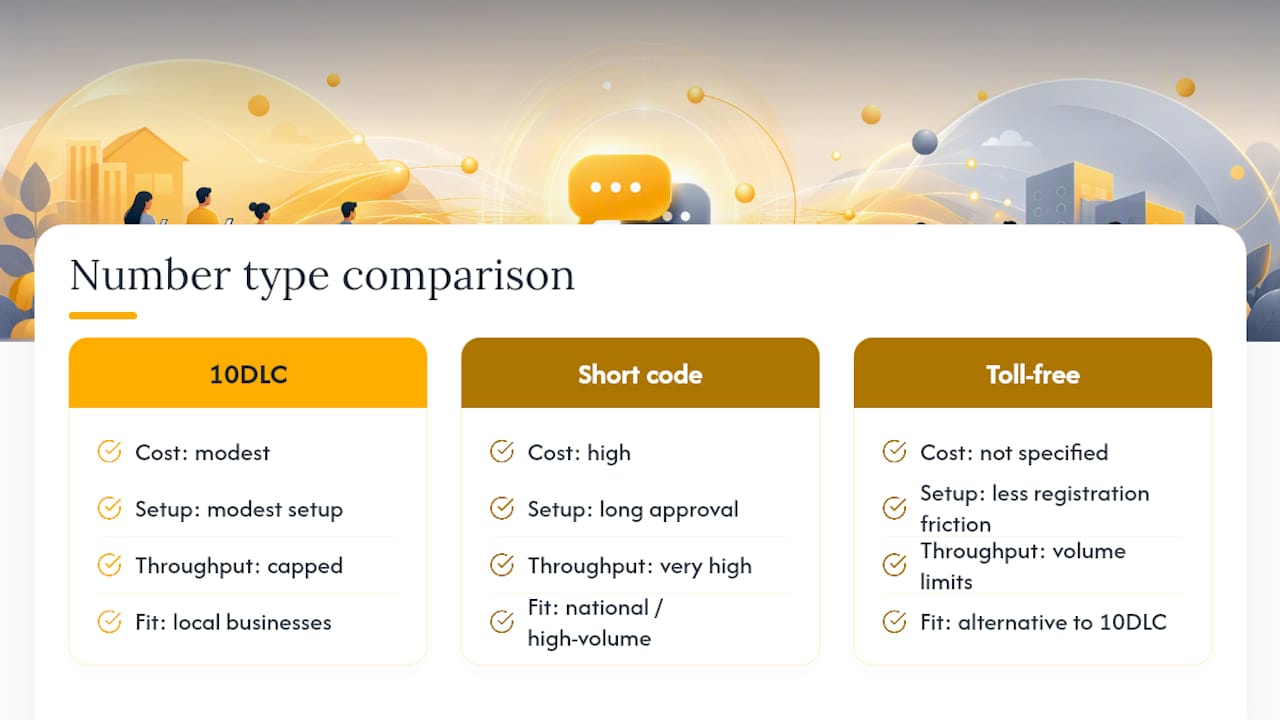
Every two-way program starts with a number, and which kind of number you pick determines cost, speed, and how much volume you can push.
Long codes (10DLC): standard 10-digit local numbers registered for business use through the 10DLC (10-Digit Long Code) system. Most local businesses land here. Setup costs are modest, throughput is capped but workable for single-location messaging, and the number looks like a normal local line, which builds trust with customers.
Short codes: 5 or 6-digit numbers built for high-volume blasts, think national retailers sending millions of texts a day. They cost more to lease and take longer to approve, so they rarely make sense for a single storefront or service business.
Toll-free numbers: an alternative to 10DLC that skips some registration friction but comes with its own verification process and volume limits.
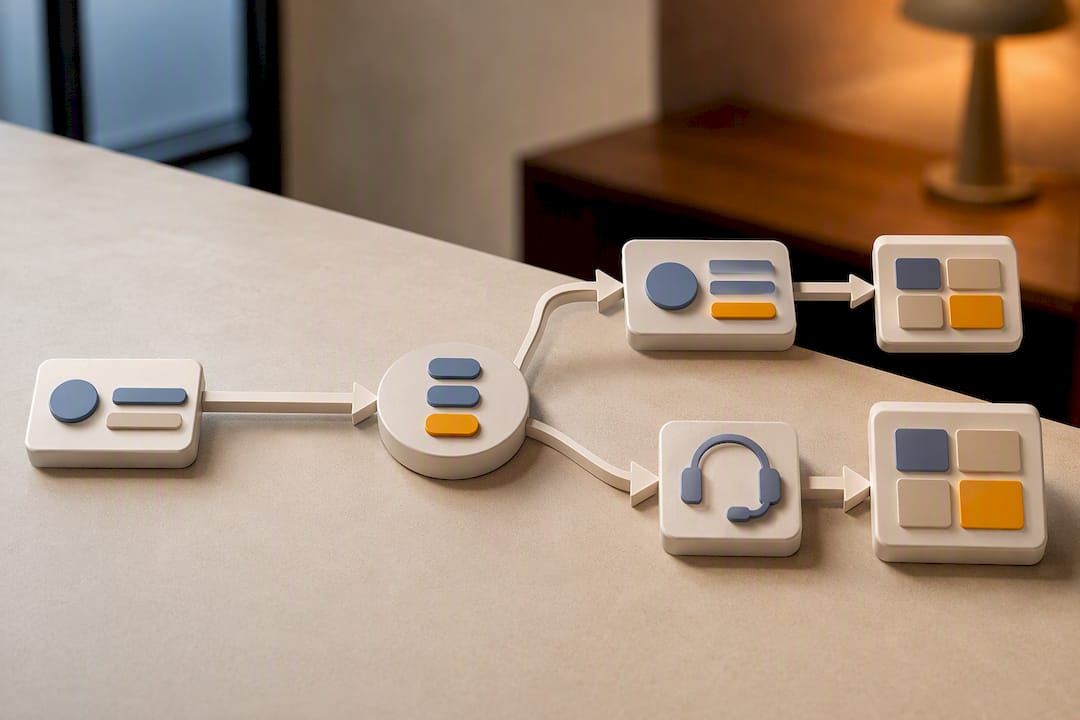
Once a number is live, keywords do the routing. A customer texting “STOP” triggers an automatic opt-out. “CONFIRM,” “RESCHEDULE,” or “INFO” can trigger a specific automated response or flag a message for a human. Behind the scenes, platforms deliver those inbound replies to your software through webhooks and APIs, which is what lets a text land directly in a CRM record instead of sitting in a phone’s inbox.
The best setups blend automation with a human safety net. A keyword can auto-confirm an appointment instantly, but anything outside a recognized pattern, a complaint, a question about pricing, a complicated reschedule, should escalate to a live agent within minutes, not hours.
Pro Tip: Build your keyword list before you launch, not after. Map out every likely reply (CONFIRM, CANCEL, INFO, STOP, HELP) and decide what happens for each one, including the replies that don’t match anything on your list.
Business Use Cases That Actually Move Revenue
Not every two-way workflow deserves a spot in your first rollout. These five consistently produce the fastest payoff for local businesses:
- Customer support and delivery coordination. A customer asking “Where’s my order?” gets an instant, specific answer instead of waiting on hold.
- Appointment confirmations and rescheduling. Two-way reply options cut no-show rates because rescheduling takes one text instead of a phone call during business hours.
- Abandoned-cart recovery and promotions. A “Still interested? Reply YES for free shipping” message recovers sales that a generic email reminder never would.
- Feedback, reviews, and post-service follow-up. Texting “How did we do? Reply 1 to 5” right after a job finishes catches sentiment while it’s fresh, and a good reply is the moment to ask for a public review.
- Lead qualification via text. A quick back-and-forth (“What service are you looking for? Budget range?”) filters serious buyers from browsers before a salesperson ever picks up the phone.
Each of these works because the reply option removes a step. The customer doesn’t have to open an app, dial a number, or wait for a callback. They just answer the text they already have open.
Best Practices for Compliance, Message Design, and Channel Choice
Opt-in isn’t optional, and getting it wrong is the fastest way to get your number blocked. Double opt-in, where a customer signs up and then confirms with a reply like “YES” or “JOIN,” gives you a documented trail proving consent, which matters if a carrier or regulator ever asks.
The FCC publishes consumer-facing guidance on unwanted texts and robocalls that outlines what businesses need to respect: clear consent, an easy opt-out, and no deceptive sender identification. Build every campaign against that baseline rather than guessing at what’s allowed.
Why speed matters: SMS open rates run far higher than email, and reply speed on text tends to be dramatically faster than email response times, which is exactly why customers expect a quick answer once they’ve replied.
A few design rules keep programs healthy:
- Always include an opt-out line (“Reply STOP to unsubscribe”) on the first message and periodically after.
- Keep frequency reasonable. Texting daily for a weekly service invites opt-outs and spam complaints.
- Use MMS (picture messaging) when a photo answers the question faster than words, a repaired part, a menu, a finished haircut.
- Consider richer channels like RCS or WhatsApp Business for customers who prefer app-based messaging, though standard SMS is not encrypted, so never send sensitive personal or payment details over plain text regardless of channel.
Every template should answer three questions before it goes out: what’s the call to action, what reply do you expect, and where does that reply route once it lands.
Implementing Two-Way Texting: Integration, Workflow, and Staffing
A pilot succeeds or fails on the setup work done before the first message goes out. Work through these steps in order:
- Connect a unified inbox. Replies from SMS, webchat, and social messages should land in one place, not four different apps your staff has to check separately.
- Sync contacts to your CRM. Every inbound text should attach to an existing customer record automatically, not create a duplicate entry.
- Map your webhook or API routing. Decide which keywords trigger automation and which route straight to a human queue.
- Write your escalation rules. Define exactly when a bot hands off, after one unmatched reply, after a complaint word, after a certain time delay.
- Set response time targets. A common target is under 5 minutes during business hours for anything escalated to a person; slower than that and customers assume no one’s watching.
- Scope your pilot narrowly. Pick one workflow, appointment confirmations or delivery updates, run it for two to four weeks, and measure before expanding.
Pro Tip: Don’t launch five workflows at once. Run one long enough to see real response patterns, fix the keyword gaps you missed, then add the next.
Staffing matters more than most businesses expect going in. Even a heavily automated program needs someone checking the escalation queue during business hours, because a customer who gets ignored after replying is worse off than one who never texted at all.
Costs and Deliverability: What 10DLC Really Means for Your Budget
Pricing for two-way texting usually falls into one of three models: per-message rates, prepaid message credits, or a monthly seat price bundled into a broader messaging or CRM platform. Short codes carry their own separate leasing fees, often running into the thousands annually, which is why most local businesses stick with a registered long code instead.
In the United States, 10DLC registration is required to preserve deliverability on standard long codes used for business messaging. Skipping registration, or registering with a use case that doesn’t match what you actually send, is one of the most common reasons a business’s texts start getting silently filtered by carriers weeks after launch.
Deliverability reality check: businesses that underbudget for registration fees and ongoing monitoring are the ones most likely to hit filtering problems after their program is already live, not before.
A few fixes address most filtering issues:
- Confirm your 10DLC use case matches your actual message content (marketing vs. conversational vs. two-factor).
- Avoid spam-trigger patterns: excessive links, all caps, or identical message text sent to large batches at once.
- Warm up sending volume gradually instead of blasting your full list on day one.
- Monitor delivery reports weekly, not just when a customer complains.
Short codes are worth the premium only when volume is high enough, generally tens of thousands of messages a month, that per-message savings and higher throughput outweigh the setup cost.
Measuring Success: The KPIs That Prove It’s Working
Track deliverability rate first. If messages aren’t arriving, nothing else matters. From there, watch response rate (what percentage of recipients reply), average response time on your end, and conversion uplift on whatever action you’re driving, bookings, confirmed appointments, recovered carts.
- Deliverability rate: percentage of sent messages that actually reach a handset.
- Response rate: percentage of recipients who reply at all.
- Average response time: how fast your team answers once a customer replies.
- Conversion uplift: the change in your target action compared to your previous channel.
- Qualitative signals: CSAT scores, drop in phone call volume, and review counts after adding text-based follow-up.
Run A/B tests on send time and CTA wording before scaling a workflow company-wide, and always compare uplift against a control group rather than assuming the channel alone caused the change.
Why Most Businesses Get Two-Way Texting Backwards
Most advice on this topic treats two-way texting as a messaging feature you turn on. It isn’t. It’s an operations decision disguised as a messaging decision, and the businesses that struggle with it almost always skipped the operational part: who answers, how fast, and what happens when a reply doesn’t match any expected keyword.
The compliance side gets treated the same way, as a checkbox instead of infrastructure. Opt-in language and 10DLC registration aren’t paperwork you clear once and forget. They’re the plumbing that determines whether your messages arrive at all six months from now, and the businesses that treat them as an afterthought are the ones quietly losing deliverability without noticing until response rates mysteriously drop.
The other blind spot: businesses assume automation replaces staffing. It doesn’t. Automation handles the predictable 80%, confirmations, simple FAQs, opt-outs. The remaining 20% is where customers actually get frustrated if no human shows up, and that is the exact segment most pilots forget to staff for. A text thread that goes unanswered after a customer replies does more damage to trust than never offering texting at all.
The businesses that get this right start narrow, one workflow, one clear success metric, and expand only once the operational side is proven, not just the message copy.
— Kentarian
Pilot Two-Way Texting With Brownbagconsultant
Brownbagconsultant is built for the operational gap most two-way texting pilots stumble on: it puts SMS, webchat, Facebook, and Google Business Message replies into one unified inbox instead of scattering them across four apps and a phone. That means the escalation and staffing problem covered above is already solved before your first message goes out.
A pilot through Brownbagconsultant typically covers one workflow, with common starting points like appointment confirmations or missed-call text-back, plus onboarding support and reporting to monitor response rates and conversion lift. The platform also layers in automated review requests and text-to-pay invoicing, so a confirmation thread can turn into a collected payment without switching tools. For guidance on structuring the templates and routing rules behind that first workflow, Brownbagconsultant’s guide to organizing conversations in one inbox walks through the setup. Check current plans and pricing and start a pilot on your highest-friction workflow this week.
Sources
- What is two-way text messaging? Conversational business SMS — NICE
- Stop Unwanted Robocalls and Texts — FCC
- Two-way SMS messaging in AWS End User Messaging SMS — AWS docs
- Receiving Two-Way SMS and MMS Messages with Twilio — Twilio Help Center