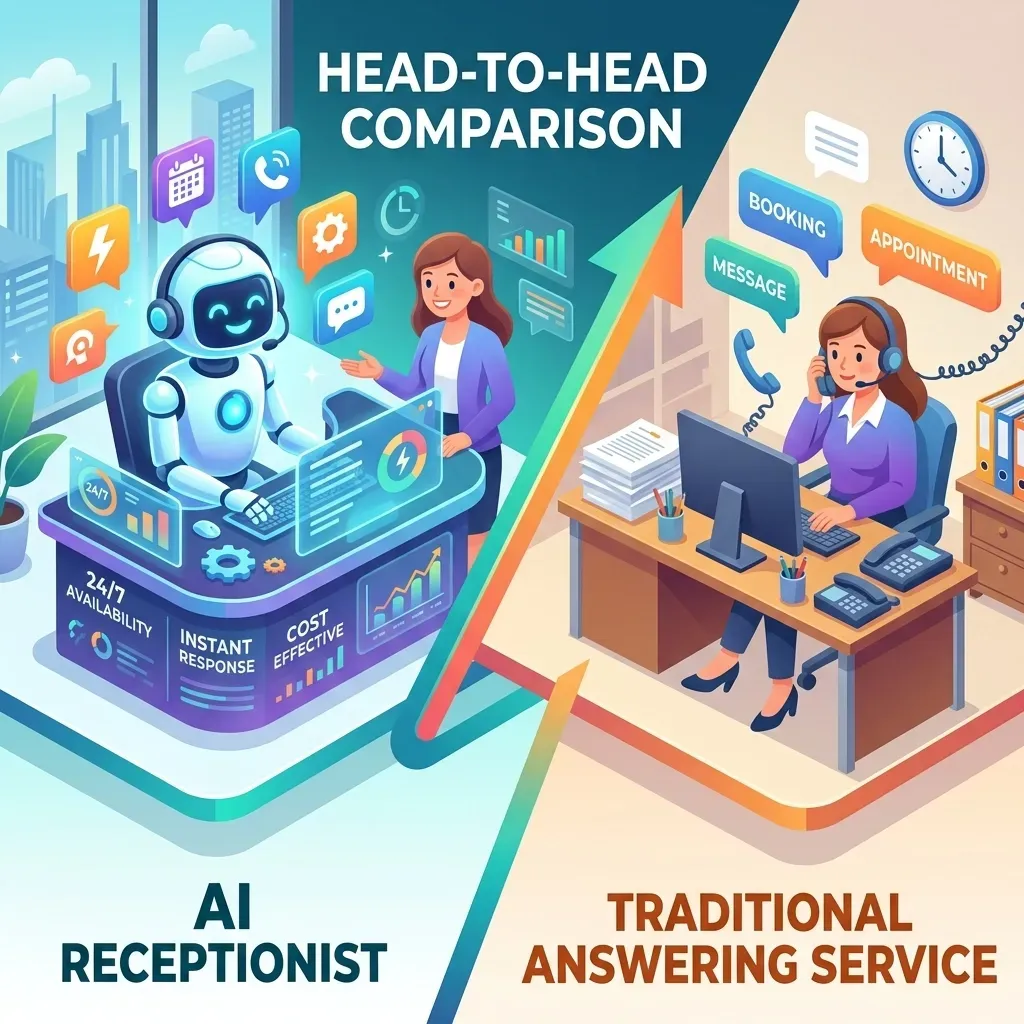
AI Receptionist vs. Traditional Answering Service: A Head-to-Head Compariso
AI Receptionist vs. Traditional Answering Service: A Head-to-Head Comparison
![[HERO] AI Receptionist vs. Traditional Answering Service: A Head-to-Head Comparison](https://cdn.marblism.com/DC0AZNni11U.webp "[HERO] AI Receptionist vs. Traditional Answering Service: A Head-to-Head Comparison")
Let’s be real for a second: if you’re running a small business, your phone is your lifeline. It’s also your biggest headache.
Every time that phone rings, it’s a potential customer ready to drop money. But if you’re out in the field, in a meeting, or, heaven forbid, trying to have dinner with your family, that ringing is just stress. You have two choices to keep the gears turning 24/7: hire a traditional answering service or lean into the future with an AI receptionist.
At BrownBag Consultants, we see business owners struggling with this choice every day. Do you want a human voice that takes a message, or a smart AI voice agent for small business that actually gets the job done?
Let’s break down the head-to-head reality of these two options. Spoiler alert: one of them is going to save you a fortune while making you look like a tech genius.
The Old Guard: What Is a Traditional Answering Service?
We’ve all dealt with them. A traditional answering service is essentially a call center filled with operators who handle calls for hundreds of different companies. When a customer calls your number, it gets routed to one of these operators. They read a script, take a name and number, and tell the customer, “Someone will get back to you.”
On the surface, it sounds fine. A human is answering, right? But here’s the problem: they are professional message-takers, not professional business-closers.
The Pros:
Human Touch: Sometimes people just want to vent to a person.
Basic Empathy: A human can hear if a customer is frantic and (hopefully) react accordingly.
The Cons:
The Infamous Callback: This is the deal-breaker. They don't book the job; they just tell you that you need to call the person back. Now you’re playing phone tag.
Variable Quality: Depending on who picks up, your brand might sound professional or like a bored teenager in a basement.
High Costs: You’re paying for human labor, which isn't cheap.

The New Standard: The AI Receptionist
An AI receptionist, or a smart AI voice agent for small business, is a different beast entirely. It’s not a "press 1 for sales" menu from 1998. It’s an intelligent system trained on your specific business data. It answers instantly, understands natural language, and, most importantly, it can actually take action.
Instead of saying "I'll take a message," the AI says, "I see we have an opening at 2 PM on Tuesday. Should I put you down for that?"
The Pros:
Instant Action: It doesn't just take messages; it books appointments, answers FAQs, and qualifies leads.
Zero Wait Time: No hold music. No "please stay on the line." It answers on the first ring, every single time.
Infinite Scalability: It can handle 50 calls at once. Try doing that with a human answering service without your bill skyrocketing.
Integration: It hooks directly into your all-in-one reviews and messaging platform, keeping everything in one place.
The Cons:
No Physical Presence: It can’t physically go out and fix the leaky pipe (yet).
Complex Edge Cases: While it’s getting better every day, extremely weird, one-off questions might still need a human touch.
Head-to-Head: The Key Metrics
Let's look at the numbers and the operational reality. If you want to see how these numbers fit into your specific budget, check out our pricing page.
1. The Cost Factor
A traditional answering service usually charges a base fee plus a high per-minute rate. You’re looking at anywhere from $200 to $1,500 a month depending on your volume. And don't forget the "after-hours" premiums.
An AI receptionist typically runs between $99 and $399 a month with significantly lower per-minute costs. On average, businesses switching to AI save 60–80% on their monthly communication bill.
2. Speed and Availability
When a lead calls, you have about five minutes to respond before they call your competitor.
Answering Service: Might take 30–60 seconds to answer. If they’re busy, your customer hits a hold queue.
AI: Answers on ring zero. 24/7/365. It never calls in sick, and it doesn't take lunch breaks.
3. The "Callback Gap"
This is where the real money is lost. Research shows that every callback required by an answering service costs your staff 3–5 minutes of time. You have to call back, check the calendar, confirm the time, and log the info.
If you get 100 calls a month, that’s 500 minutes of your staff’s time wasted on administrative back-and-forth. An AI receptionist eliminates the callback gap by booking the appointment directly into your calendar while the customer is still on the phone.
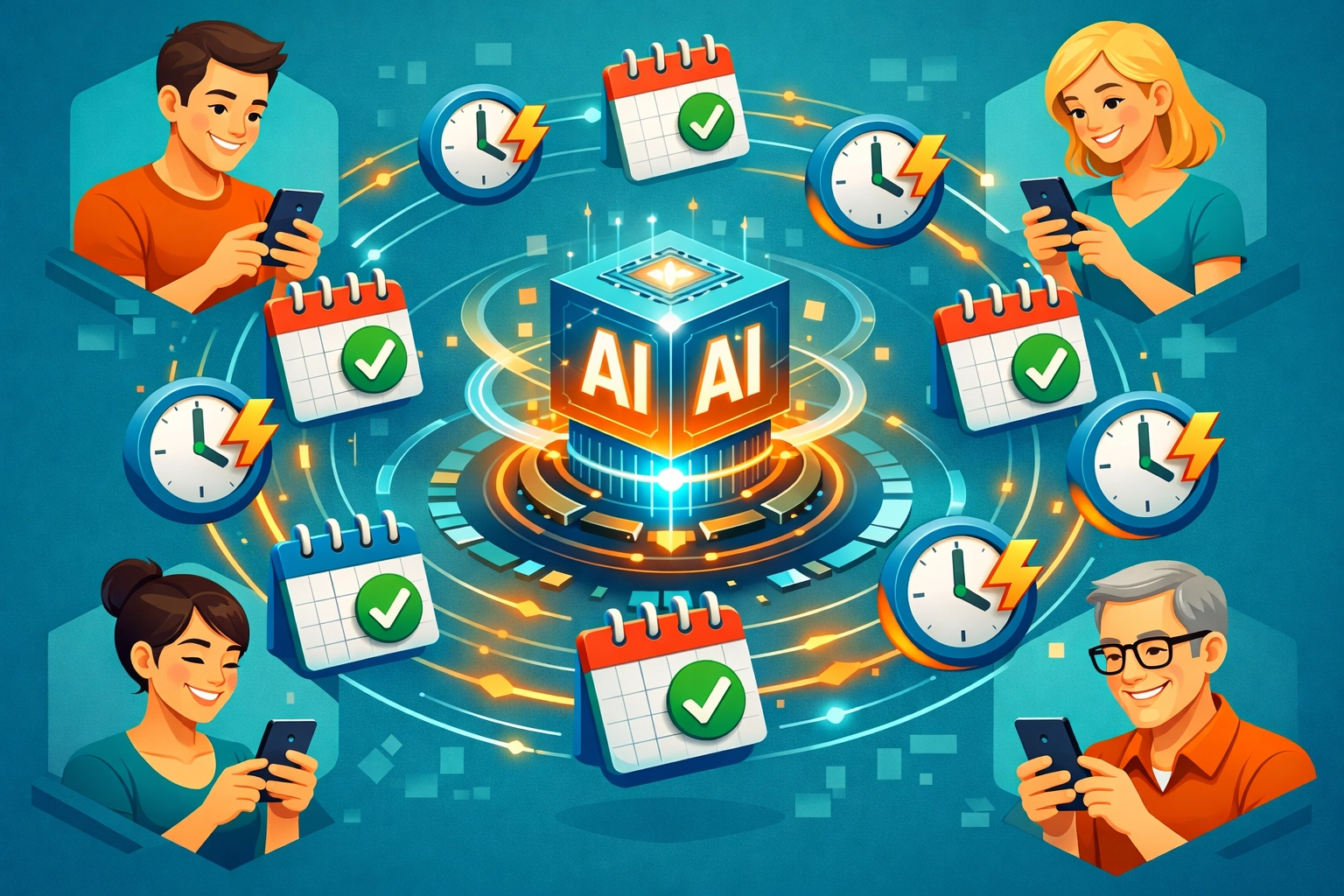
Why AI Wins the 24/7 Game
Imagine it’s 8:00 PM on a Tuesday. A homeowner’s AC just died. They are stressed and calling every HVAC pro on Google.
Scenario A (Answering Service):
The customer calls. An operator answers after 45 seconds. They take the name and number. They say, "We'll have someone call you in the morning." The customer hangs up and calls the next person on the list because they need a solution now.
Scenario B (AI Receptionist):
The customer calls. The AI answers instantly. It says, "I'm so sorry your AC is out. We actually have an emergency technician available at 8:00 AM tomorrow. Would you like to book that slot?" The customer says yes, receives a confirmation text immediately, and stops calling other companies.
In Scenario B, you won the job. In Scenario A, you paid for a message that resulted in a lost lead. This is why tools like the Social Scale System are becoming the backbone of modern service businesses.
Integration: The Power of an All-in-One Platform
One of the biggest advantages of an AI voice agent is that it doesn't live in a vacuum. When you use an all-in-one reviews and messaging platform, that phone call becomes part of a larger ecosystem.
Missed Call Text-Back: If the AI happens to be busy (rare) or if the customer hangs up, the system automatically sends a text: "Hey, sorry we missed you! How can we help?"
Review Management: Once the AI books the job and your team completes it, the system can automatically trigger a review request.
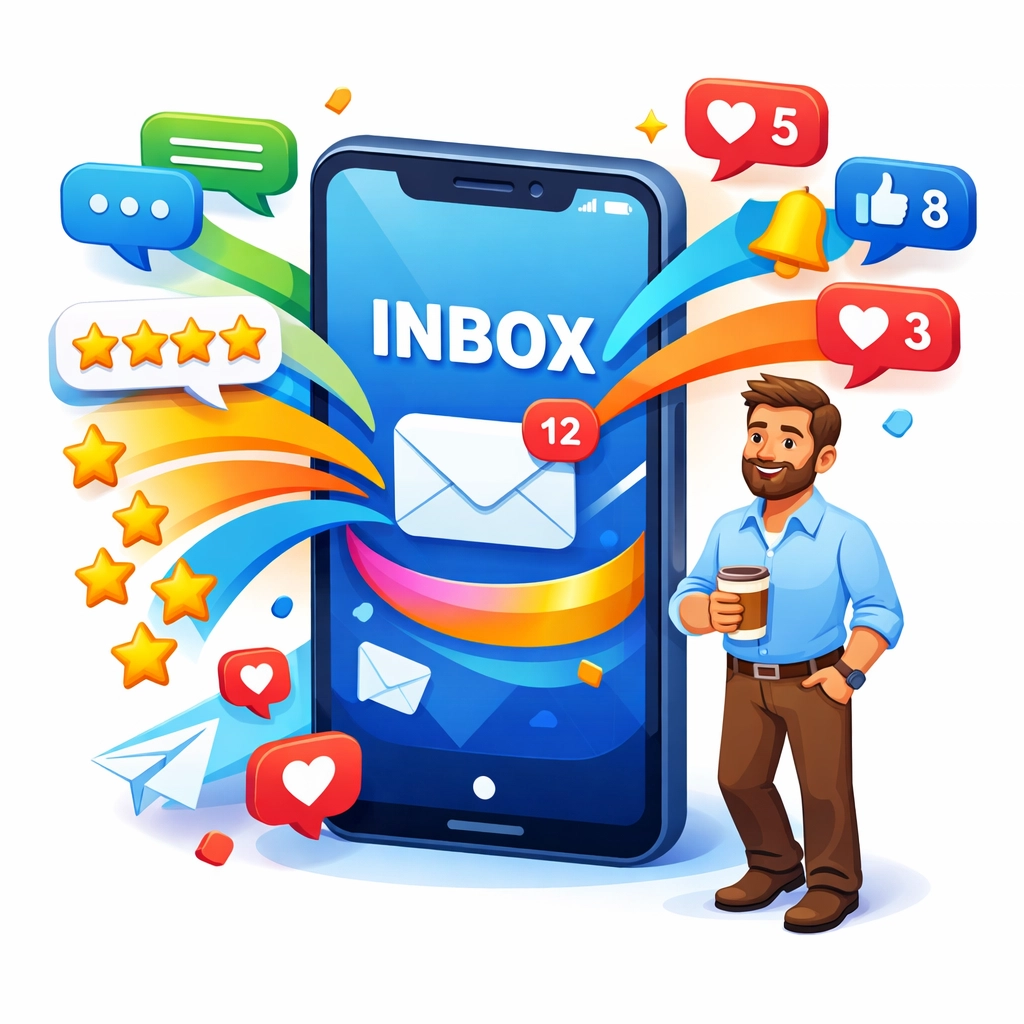
Unified Inbox: The transcript of the AI's conversation is sitting in your inbox alongside your Facebook messages, Instagram DMs, and texts.
This level of efficiency is simply impossible with a traditional human answering service.
Is It Time to Make the Switch?
Look, we get it. Change is scary. You might worry that your customers will "know it's a robot." But here’s the truth: in 2026, customers value speed and resolution over a polite human who can't actually help them.
They would much rather talk to a clear, efficient AI that solves their problem in two minutes than wait on hold for a human who tells them to wait for a callback.
If you’re still on the fence, the best thing you can do is see it in action. You can schedule a call with us to discuss your specific needs, or better yet, grab a free demo to hear how the technology sounds for yourself.
Final Verdict
Traditional Answering Service: Good for complex, high-empathy scenarios where no immediate action is required. It’s a expensive, slow, and reactive way to handle business.
AI Receptionist: The gold standard for any business that wants to grow. It’s proactive, affordable, and incredibly fast. It doesn't just answer the phone; it grows your business.
At BrownBag Consultants, we’re all about efficiency. We don't believe in paying more for less. The "old way" of handling calls is bleeding your business dry through lost leads and high overhead. It's time to plug the leak.
Ready to see what the future of your business sounds like? Let’s get started.